Build Constellations, Not Stars. Four Network Principles for Collaboration.

Photo by Ryan Hutton on Unsplash
Jane Wei-Skillern and Nora Silver of U.C. Berkeley have distilled four key principles for Network Leadership in this article (the most popular in the 15-year history of The Foundation Review!). Their principles draw on decades of research on networked approaches to social change and a deep dive on the Energy Foundation - a collaboration between McArthur, Pew and Rockefeller foundations to advance clean energy policy.
So what are they?
Focus on the Mission before the Organization
Social impact organizations - and those who fund them - can fall into the trap of focusing on organizational growth and scale as a proxy for impact. But, Jane and Nora remind us that impact is about the mission not the organization. Focusing on organizational growth may blind you to great solutions and approaches because they don’t pay for your people or keep the lights on. Effective network leaders lean into this tension by asking “How can we achieve leveraged impact rather than organizational scale?”
⟡
Build Partnerships Based on Trust, Not Control
This point seems to be mainly geared towards funders who Jane and Nora observe can try to orchestrate collaboration from top down, strategic maps rather than real relationships on the ground. The idea is that what makes collaboration work is the social capital among organizations - and the invitation is to build on what’s already in place. The Energy Foundation did this by enabling grantees to use their unrestricted funds to support the work of their peers - tapping into the wisdom of the community about who is best positioned to lead what work. Genius.
⟡
Promote Others Rather than Yourself
In these times of the influencer and strong man, this principle can feel a bit pollyanna, but according to Jane and Nora, humility is the way of effective Network Leaders. Lift up others, celebrate their successes, stay behind the scenes while the mission takes center stage. Of course, it’s a balancing act, a careful dance. Institutional visibility can help to bring credibility and greater understanding to the work, but sucking all the oxygen from the room is guaranteed to leave you working alone.
⟡
Build Constellations, Not Stars
These four principles weave together a central point - center the mission not the individual or the organization. In this principle, Network Leaders position themselves in a wider constellation orbiting a bigger purpose rather than placing themselves at the center. The diagram below illustrates how the Energy Foundation helped to build a constellation of organizations with clean energy policy as the gravitational force.
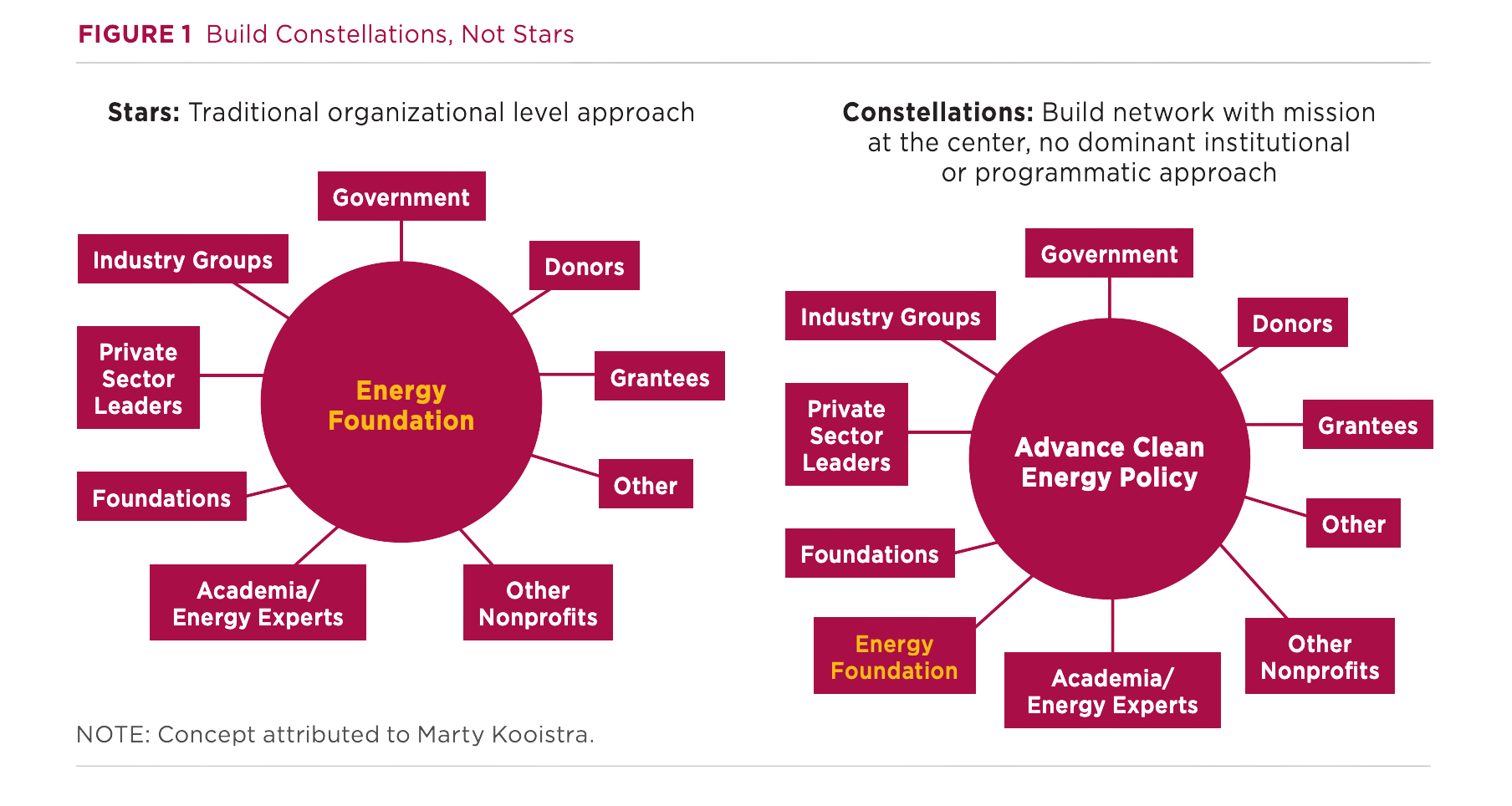
In summary, Jane and Nora’s position is that while network structures, governance, and tech tools are essential components for leading effective networks, what’s often overlooked, but even more fundamental to success, are the leadership skills and cultural elements of network building.
⟡
Invitation to Funders
Jane and Nora’s message is primarily aimed at funders. They suggest four things you can do as a philanthropist or impact investor to advance more collaboration within your spheres of influence:
Invest in Network Leaders - people who embody these leadership qualities and have a track record of working through networks.
Provide long-term unrestricted or experimentation capital to unlock the potential of networks.
Redesign your performance metrics so they are relevant for network-level impacts.
Consider working in networks yourself - collaborating with other funders to bring more coherence to your mission. (We love this example of EFSAF - a constellation of European foundations collaborating on the transition to sustainable agriculture.)
We’re sold. Network Leadership is about de-centering the org and your ego and working for a bigger North Star.